

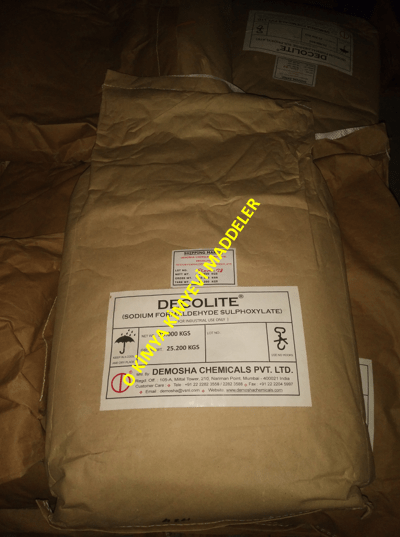
 SODIUM FORMALDEHYDE SULFOXYLATE RONGALITE C PACKAGING
Product Documents |
|
| SODIUM FORMALDEHYDE SULFOXYLATE CERTIFICATE OF ANALYSIS | |
What is Sodium Formaldehyde Sulfoxylate (Rongalite C)?
Molecular Formula (Sodium Formaldehyde Sulfoxylate (Rongalite C)); CH3NaO3S / CH3NaO3S.2H2O
Molecular Weight; 118.09 g/mol
Chemical Name; Rongalite
CAS Number; 149-44-0 / 6035-47-8 (DIHYDRATE)
It exists in two forms: anhydrous and dihydrate.
Through its functions, it can add emulsifying properties and also create a catalytic effect. It can be used as a raw material. Rongalite C acts as a reducing agent.
Other Names Are as Follows;
- Sodium hydroxymethanesulfinate
- Sodium Formaldehydesulfoxylate
- Formaldehydesulfoxylate
- Formaldehydesulfoxylate Dihydrate
- Formaldehydesulfoxylate Monosodium Salt
- Rongalite
- Rongalit
- Sodium Hydroxymethanesulfate
- Sodium Methanesulfoxylate
- Natrium Hydroxymethanesulfinate
- Methanesulfinic acid, hydroxy-, monosodium salt
- Hydroxymethanesulfinic Acid Sodium Salt
- SODIUM FORMALDEHYDESULFOXYLATE
- Sodium Oxymethanesulfinic Acid
- Sodium (Hydroxymethyl)sulfinate
- Sodium Oxymethylene Sulfoxylate
How is it Produced?
The production of Sodium Formaldehyde Sulfoxylate is described on a small scale below. This production is very similar to the commercial industrial production process but at a micro level.
In the production process, it has been observed that a very different reaction occurs when 1 mole of Formaldehyde acts on 1 mole of Hydrosulfite in the presence of Sodium Hydroxide.
If a solution of 1 mole of Sodium Hydrosulfite, 1 mole of Sodium Hydroxide solution, and 1 mole of formaldehyde solution are shaken, an exothermic reaction occurs. In the production of Rongalite C, the reduction potential of the solution, compared to an indigo carmine solution in the cold, is lost after a while.
In the ongoing process, if the solution is mixed with an equal volume of alcohol, neutral sodium hydrosulfite will precipitate. When this solution is evaporated, a syrup-like chemical is formed.
During this process, it was recrystallized from water, in which it is very soluble, as well as from hot ethanol. At this stage of Sodium Formaldehyde Sulfoxylate formation, prismatic crystals form first. Subsequently, large-sized silvery flakes appear. The chemical formed here corresponds to the formula NaHSO2·CH2O·2H2O.
The production reaction for Sodium Formaldehyde Sulfoxylate (Rongalite C) is as follows;
CH2O + Na2S2O4 + NaOH 》NaHSO2·CH2O + Na2SO3.
What are the Chemical Properties of Sodium Formaldehyde Sulfoxylate (Rongalite C)?
It is a hard, white solid.
Its melting point is 63-64 °C.
When heated to decomposition, it emits toxic fumes of Sulfur Oxides and Sodium Oxides. Rongalite C has alkaline properties.
Its pH value is 9.5-10.5.
Melting point is 120 °C.
Solubility is 50 g/L at 20 °C. It is a chemical with a very strong odor.
Its flash point is above 100 °C.
It is a stable chemical. It is incompatible with strong oxidizing agents.
What are its effects on human health?
It may cause skin irritation. It also has chemical effects that can cause serious eye irritation. It may cause respiratory irritation.
One of the major effects of Rongalite C is that it is suspected of causing genetic defects.
Protective gloves should be worn while working. Avoid inhaling its fumes.
In case of contact with hands or face, it should be washed with water for a few minutes.
How is it Stored?
It should be stored in a cool, dry place.
Sodium Formaldehyde Sulfoxylate is stored in 25 kg packages.
It should be stored in areas away from direct sunlight.
What are the Usage Areas of Sodium Formaldehyde Sulfoxylate (Rongalite C)?
- Sodium Formaldehyde Sulfoxylate (Rongalite C) has functional properties as a catalyst, emulsifier, raw material, and reducing agent.
- It is actively used in the pharmaceutical, textile, rubber, plastic, and adhesive industries.
- In the plastics industry, Rongalite C is used as a catalyst and polymerization regulator during manufacturing.
- In rubber manufacturing, it is used as a redox activator.
- It is used as a reducing agent for redox-catalyzed polymerization. Thus, it is also a reducing agent.
- In paint manufacturing, it is used as a paint raw material.
- In the textile industry, sodium formaldehyde sulfoxylate is used as a stripping and discharge agent.
- It is used as a reducing agent in vat dyeing processes.
- Rongalite C is used as a bleaching agent in the production of soap and molasses.
- It is used as an antioxidant in the manufacturing of some pharmaceutical drugs.
- It is used as an active ingredient in drugs for the treatment of mercury poisoning.
- Rongalite C is used in the manufacturing of adhesive products for packaging used in the food industry.
- It is used for its catalytic effect during the polymerization process in the manufacturing of paper and paperboard that comes into contact with aqueous and fatty foods.
- Rongalite C is used in fabric production to make the resulting fabric softer and more flexible.
- It is used in the manufacturing of sealing gaskets for food containers.
- It is used in the manufacturing of rubber articles for repeated use in contact with food.
- Sodium formaldehyde sulfoxylate is used as an emulsifier in the manufacturing of products that come into contact with food.
What Factors Affect its Prices?
The prices of Sodium Formaldehyde Sulfoxylate (Rongalite C) change in parallel with the prices of the chemicals used in its production.
In terms of price, as the prices of formaldehyde, sodium hydroxide, and sodium hydrosulfite increase, the price of Rongalite C also increases.
It has been showing a long-term upward trend with industrial development.
The price of Sodium Formaldehyde Sulfoxylate (Rongalite C) increases as its areas of application expand.