

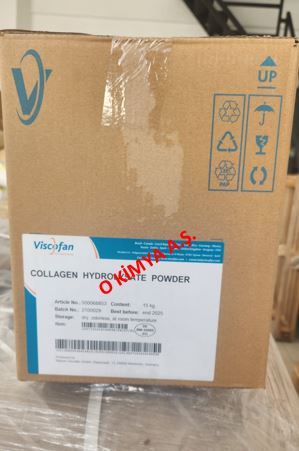
COLLAGEN PACKAGING
Product Documents | |
What is Collagen?
Molecular Formula (Collagen): C57H91N19O16
Molecular Weight: 1302.5 g/mol
Chemical Name: Collagen
CAS Number: 9007-34-5
They are known as the fibrous proteins of the matrix. They can be found within the extracellular matrix of proteins and within the connective tissue. They are among the most abundant proteins in animals.
There are at least 16 types of collagen. However, 80-90% of these consist of Type I, Type II, and Type III.
30% of the body protein that forms body tissues is collagen connective tissue protein.
Collagens can be found in many tissues in the body. Cells produce collagen. After a certain age, the human body's collagen production decreases and stops over time.
Other Names are as Follows;
Collagen
Collagen Powder
Collagen Type 1
Collagen Type 2
Collagen Type 3
Bovine Collagen
Bovine Articular Cartilage
Collagen 99%
Collagen Hydrolysate
How is it Produced?
Detailed information regarding the production of this compound is not available. However, collagen production involves extracting bovine tendons with a disodium hydrogen phosphate solution and potassium chloride. Then, the obtained compound is washed and dried to produce the final product.
What are the Physical and Chemical Properties?
It is an electrolyte exhibiting amphoteric properties. They can provide a negative or positive charge at a certain pH level with dissociation capability. As can be understood from this, collagens can transform into positively and negatively charged states.
Collagens have different viscosities. The lower the temperature, the higher the viscosity.
Their aqueous solutions are in a colloidal structure and have a certain viscosity.
Density: 1.3 – 1.4 g/cm³
Melting Point: No information available
Boiling Point: No information available
Solubility: Soluble in water.
The Composition of Collagen Proteins is as Follows;
Aspartate
Alanine
Arginine
Glycine
Other Amino Acids
Glutamate
Proline and Hydroxyproline
What are the Usage Areas of Collagen?
Human skin is subject to aging over time. Therefore, collagen is used in cosmetic products to eliminate wrinkles on the skin and provide a plump and smooth skin appearance.
It is used in the manufacture of day creams to obtain soft and youthful-looking skin.
It is used in the manufacture of tonics, which are cosmetic products applied with moisturizers and serums.
It is used in the manufacture of care serums containing Hyaluronic Acid and many peptides, together with substances containing many amino acids.
It is used in the production of softening and moisturizing serums.
It is used in the manufacture of face masks produced to delay the aging occurring on the skin.
In the aesthetic sector, it is used in the production of products such as collagen-based fillers, which are injected under the skin to heal scars, provide volume, and eliminate wrinkles.
Collagen peptides are used in the production of creams that have a moisturizing property for approximately 1 day.
It is an important component for meeting the needs of people requiring Hydroxy Silicin and hydroxyproline. This is because these substances are present in higher amounts in collagen compared to other proteins.
What Factors Affect the Prices?
Collagen prices have risen significantly recently with the intensification of its use in the cosmetics sector. Since collagen production is a challenging process, it is a compound with a medium-level cost.
Companies that are collagen distributors control the prices of this chemical substance. In the case of high stock levels, prices will experience short-term decreases.
Collagen Sales
Chemical substances are packaged in packages determined by international standards. These are sold starting from the smallest package to the largest package or in bulk with tanker. These can be 1 gram packaging, 1 ton big bag packaging, the smallest drum packaging, or packaging-free sales with tanker.
All information here should be used in accordance with the legislation by expert people and professionals in the field.